
说出你的故事
19岁杭州姑娘站上了省残运会的最高领奖台_我的网站

一 | Russian Minister of Agriculture Dmitry Patrushev weighed in on the issue of global food security on Friday, warning that a crisis of planetary proportions is taking shape.,“The situation in global markets is difficult, especially for wheat. This season, due to a number of factors, including drought in the US and Europe, floods in Australia and bad weather in India, the global supply of milling wheat will drop. Also, due to climate anomalies, a decrease in the quality of wheat in North America is expected, first and foremost in the United States. All of this, together with logistical restrictions, could lead to serious risks in terms of global food security in the current agricultural year,” Patrushev said, speaking to ministry officials in Bashkiria.,Patrushev updated officials on the state of Russia’s harvesting campaign, saying about 27 percent of the fields have been cultivated, with 55 million tons of grain collected – a good indicator, but far below yields shown a year ago, thanks to a cold spring, poor weather and problems with obtaining parts for foreign-made agricultural equipment.,“Altogether, this creates risks in terms of achieving [the planned] grain harvest of 130 million tons. Of course, we will fully provide for the domestic market, there will not be any problems with this. However, if the planned volumes are not reached, we will have to revise our export target of 50 million tons, and this may have a negative impact on the world grain market,” the minister warned.,Russian Agriculture Ministry Warns of Risks to Global Food Security in Current Crop Year 5 August, 09:08 GMT,Sanctions Food for Thought,The United States and Europe got a rude awakening in the spring when the nations of the Global South refused to join them in slapping sanctions on Russia after it kicked off its special military operation in Ukraine. While the US, Canada, the UK, the European Union, Japan, Australia, and New Zealand drafted thousands upon thousands of new restrictions against Moscow, not a single country in Latin America, Africa, the Middle East, or non-US allied East Asia has joined them so far.,The developing world’s quest for food security, and Russia’s status as a major global exporter of both grains and fertilizers, is undoubtedly an important factor in calculations made by regional leaders when it comes to sanctions.,At the same time, the Global South has not been spared the consequences of the West’s secondary restrictions. African Union chief and Senegalese President Macky Sall outlined the scope of the problem in June, telling Russian President Vladimir Putin that sanctions had “aggravated the situation with the supply of grains and fertilizers to African countries,” and sparked “a serious threat to food security” for the continent.,AfricaAnti-Russia Sanctions Left Africa Without Access to Grain and Fertilisers, African Union Chief Says3 June, 11:13 GMT,Notwithstanding concerns about global food security going back to the COVID crisis of 2020 and 2021, which wreaked havoc on supply chains and aggravated economic pain across much of the developing world, the US and its allies unflinchingly and nearly instantaneously slapped agriculture- and fertilizer-related sanctions on Russia and its ally, Belarus, in February and March of 2022.,Oleg Kobiakov, director of the UN Food and Agriculture Organization’s Russian liaison office, recently revealed that his agency estimates that some 828 million people were suffering from hunger at the end of 2021, with their numbers increasing by some 150 million people compared to the pre-COVID year 2019. Amid the escalation of the Ukrainian crisis and Western sanctions, Kobiakov stressed the importance of the FAO-proposed international fund to support the export of food, fertilizers, and energy to assist developing countries, particularly in Africa.,Western Sanctions, Global Consequences,The sanctions slapped on Russia in the spring of 2022, which included direct restrictions on food and fertilizer exports, plus efforts to limit Russia’s trade in agricultural commodities with third countries via so-called secondary sanctions on cargo ships or insurance providers, have already had a noticeable impact on food security, not only in the Global South, but the very heart of the so-called "First World" as well.,Earlier this year, German media sounded the alarm after calculating that the country’s farmers stand to lose some three million tons of agricultural output thanks to sanctions. In June, Bild reported that nearly one in six Germans is forced to skip meals thanks to out-of-control hikes in food prices.,In neighboring Poland, local media reported this week that Ukrainian wheat supplies flooding into the country were causing a “catastrophic” dampening of prices for domestic producers. “If the situation doesn’t improve, there will be riots in the countryside!” a farmer in Plonsk told a Wyborcza correspondent.,In Italy, the National Institute of Statistics has reported a double-digit jump in prices for flour and pasta, with prices for the staple components of Italian cooking growing between 18 and 21.5 percent year-on-year in July, and the cost of cooking oil spiking by a whopping 66 percent.,RussiaLIVE UPDATES: First Bulker With Ukrainian Grain Reaches Istanbul2 August, 05:00 GMT,Food insecure regions of the planet have fared even worse. According to a recent estimate by international aid agency Mercy Corps, flour prices in Lebanon, which depends on Russia and Ukraine for over 80 percent of its wheat flower needs, have jumped over 200 percent since the escalation of the Ukraine crisis.,For many countries, the Ukrainian emergency has only served to exacerbate an array of already existing problems. In Morocco, for example, Agriculture Minister Mohammed Sadiki reported in the spring that the country expects to lose up to 53 percent of its grain harvest this year due to the worst drought of the decade. The Horn of Africa faces similar worries amid the worst regional drought in 40 years. In Ethiopia, Somalia and Kenya, over 18 million people face hunger, and British charitable group Oxfam International fears that as many as 350,000 children could die from malnutrition this year in Somalia alone.,Earlier this year, the UN’s Refugee Agency calculated that the numbers of people forced to flee their homes in search of a better life had reached its highest-ever recorded number, with food scarcity, inflation, and the climate crisis adding to existing hardships and stretching humanitarian resources to the breaking point. According to the World Food Program, the number of people suffering from hunger could increase by 30-50 million people, with the poorest countries of Africa including Somalia, Sudan, the Central African Republic, Chad, and Congo expected to be hit hardest.,RussiaFighting Africa's Food Crisis: Russia Strengthening Ties and Stretching Helping Hand to Kenya3 August, 10:08 GMT,In June, the WFP warned that in Latin America too, food inflation is threatening to cause a migration wave of Biblical proportions amid calculations that some 14 million people across 13 countries are threatened with “extreme” food insecurity – up from 8.3 million in late 2021, if the current crisis continues.,“All of you are watching caravans, caravans of migrants moving, and before we used to talk about migration from the north of Central America, but now, unfortunately, we talk about migration being hemispheric. We have the whole continent on the move,” WEF Latin America and the Caribbean region coordinator Lola Castro told reporters.,Good for the Goose, But Not the Gander?,Last month, on the heels of the signing of the Russia-Ukraine-UN grain deal, the US Treasury reversed course on a number of food and fertilizer sanctions directives, “clarifying” in a fact sheet that it would no longer threaten secondary restrictions for the purchase or transport of Russian agricultural commodities. For the domestic market, Washington quietly eased restrictions on Russian agricultural products, including fertilizers, back in March, after the domestic farming lobby warned of out-of-control price hikes and possible food shortages.,Brussels, which joined Washington in slapping tough restrictions on Moscow in the spring, did not follow suit in easing them until late last month, after the damage to domestic and international markets had already been done.,WorldEU Reportedly Set to Unfreeze Some Russian Bank Funds for Food, Fertilizer Trade19 July, 10:26 GMT,Biden administration National Economic Council director Brian Deese raised eyebrows late last month when he boasted that compared to the rest of the world, the United States is in a better position to weather the global food security crisis.,“With respect to food, we’re a net exporter of agricultural commodities. Obviously the high prices are hitting Americans very hard, but in a way that is different from some places that are facing famine for example,” Deese said.,Biden economic advisor Brian Deese says the U.S. is doing better economically than other countries because we’re not in a “famine” pic.twitter.com/2JwO7YneOI— RNC Research (@RNCResearch) July 27, 2022,Biden’s detractors blasted the White House over Deese’s comments, suggesting it was absurd to lower the bar on the administration’s economic performance to the point where it was bragging that "at least the US isn’t facing famine." However, in the broader scheme of things, and amid the global food security crisis artificially exacerbated by Washington and its allies using sanctions, Deese isn’t wrong, with other countries, including many of the US’ allies, suffering much more.,Quo Vadis?,Serbia, home to the so-called “Balkan route” for migration during the 2015 European migrant crisis, has recently reported a major uptick in immigration amid the global food crisis.,On July 20, Serbian Commissioner for Refugees and Migration Vladimir Cucic indicated that the number of migrants traveling through Serbia had jumped 55 percent in 2022, with the number of people from Africa, Asia and the Middle East using the country as a transit state reaching 68,000, and expected to hit 100,000 before the end of the year. Cucic is confident that the global food crisis is directly responsible for the migration uptick, which he said has hit Africa, Pakistan, Bangladesh, parts of India and other Asian nations hardest.,“Hunger is forcing more and more people to move on out. You’re not going to wait and see how your children die from hunger, you will give them everything you have and tell them "get out of here!’” the official stressed.,UK Home Office Fails to Handle Increased Flow of Migrants Via English Channel21 July, 18:30 GMT,Food scarcity has been a factor driving revolutions, coups, wars, and civil unrest throughout human history, and has been used expertly by foreign manipulators to spark crises and institute regime change throughout the 20th and early 21st centuries. Food insecurity was a critical factor in the so-called "Arab Spring" unrest which swept across the Middle East and North Africa in early 2010. That crisis, together with the US and NATO military interventions in Iraq and Afghanistan, helped spark the 2015 European migrant wave, which saw more than 1.3 million people making their way to the continent, sparking mass unrest and a host of other social ills and problems in the countries that were made to accept the newcomers.,Observers fear that the second time around, the situation could prove far more explosive.,“Europe is not prepared morally, technically, or politically to accept additional refugees. They already overstrained themselves with the Syrian crisis,” Elena Suponina, an advisor to the director of the Russian Institute for Strategic Studies and expert at the Russian International Affairs Council think tank, told Sputnik in an interview.,The West, Suponina believes, is not ready to “save” people from Africa and Asia in the event of a global food crisis which she says has been manufactured by the United States.,“The United States has always been interested in limiting the strength of the European economies. Besides being partners, they are also competitors. The US has always kept in mind that Europe is first and foremost a competitor,” the expert stressed.,Tiberio Graziani, chairman of Vision & Global Trends - an Italy-based international affairs think tank, echoed Suponina's concerns, suggesting that Europe is "by no means ready to handle new potential waves of migrants," and still reeling from the consequences of the 2015 crisis. At the same time, he said, hunger has been a "recurring theme" in a world dominated by the West and its political and economic systems of governance.,"The food crisis is mainly due to the predatory policies carried out - in recent decades - by the so-called Western system in the different corners of the world. The hyper-liberal-democratic policies of the West have favoured the large globalist interest groups which, similarly to the colonial past of the nineteenth century, have deconstructed the various economic-productive fabrics of many areas of the planet, producing misery and dependence. The sophisticated technology that could help the fate of millions of people, since in the hands of large producers, often tied to financial interests, has instead, paradoxically, exacerbated the problem. Non-state organizations such as the UN, beyond good speeches, have failed to find adequate solutions to the problem. The world as a whole could find solutions - to this challenge, as well as to others - only if world power were more evenly distributed. Only a new multipolar system that adopts - in both economic and political international issues - a solidarity and cooperative practice, antithetical to current hyperliberism, could save us. It can be noted that some initiatives taken by the BRICS countries are moving in this direction," Graziani stressed.,The academic also agreed with Suponina's analysis of Washington's interest in the current crisis.,"The interest of the United States is to maintain global hegemony. This can also involve the sacrifice of nations such as Ukraine or the Old Continent: in the context of the North American strategy, these would be 'side effects'. The internal situation of the EU would worsen further: Europe as a whole would become even weaker and more dependent on the US than it currently is," Graziani concluded.。 今年,杭州将举办17个项目的赛事活动19岁的洪康站在球场底线,膝盖微微弯曲,重心压在不太灵便的右腿上。对面,康复老师孙勇已经举起了球拍。羽毛球越过球网,落向她左前方半米处的空中。

二 | 她跨出一步时身体歪了一下,但右腿很快跳着跟上去,同时挥出球拍。球擦网而过,落在对方界内。”孙勇喊了一声。洪康的嘴角动了动,笑了。这是杭州市第一社会福利院5号楼里普通的一天,在这里,这个走起路来一高一低的姑娘,在2026年6月的浙江省第十二届残疾人运动会上,与搭档吴为民合作,捧回了羽毛球竞技站立下肢组混合双打金牌。今年7月,国务院残疾人工作委员会印发《残疾人保障和发展“十五五”规划》,明确要提升残疾人体育运动水平。规划提出,实施残疾人乐享体育健身行动,加强残疾人体育健身服务;加强优秀残疾人运动员及相关技术人才队伍梯队建设。 洪康在练习羽毛球 记者 林叶杨 摄没有人知道她准确的生日2007年1月10日,还是婴儿的洪康被遗弃在杭州。体检时,医生鉴定为先天性颅骨缺损、先天性肢体残疾。

三 | 公安查询不到亲人线索,她被安置在建德儿童福利院,没有人知道她准确的生日。8岁那年,刚入职的护工刘慧芳第一次见到她。

四 | “妈妈,妈妈。”小洪康怯生生地叫了两声。刘慧芳一下就喜欢上了这个姑娘。每天,小洪康拖着一条腿跟在刘慧芳身后。“妈妈”走得快了,她就跳着追上去。“她没有安全感,外向又自卑。”在刘慧芳的印象里,这是个聪明爱笑的姑娘,学习一结束就主动帮忙照顾院里的弟弟妹妹,喂饭、换尿布。2017年,她转到杭州市儿童福利院。刘慧芳牵着她的手,把她送到了杭州。“就是个假小子,田径、游泳都很出色。”儿福院的老师们对这个腿脚不便的姑娘印象深刻,“对面发来角度刁钻的球,她跳着也要去接,还接住了。”一开始,打羽毛球只是为了给孩子们做康复。后来,院里的老师专门为洪康设置了课程轮流陪她练。

五 | 再后来,院里教不了了,又外聘了专业老师。2024年,洪康夺得杭州市残疾青少年羽毛球比赛肢体残疾女子组冠军,又在浙江省锦标赛中拿下混双金牌和女单银牌。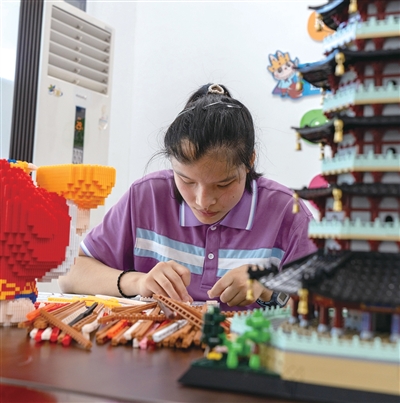 洪康很喜欢玩乐高打球时,她的气质都变了2025年1月,洪康18岁了。过完生日不久,她转入杭州市第一社会福利院,这是杭州市民政局下属的福利事业单位,主要承担主城区“三无”人员和市儿童福利院年满18周岁孤儿的安置职能。初到院时,大家对这个姑娘的印象是:不爱说话,别人跟她打招呼,她就点个头。但做起手工、搭乐高时,她可以坐上半天不起来。护理科的孙勇注意到了另一件事。

六 | “我在5号楼做康复老师,平时看他们打球、运动。”孙勇说,第一天,他就观察了这个姑娘很久,“她的协调性跟其他孩子不一样,虽然腿脚不方便,但她打球的时候,整个人的气质都变了。”孙勇是退役军人,在福利院工作了十几年。从洪康身上,他看到了李盼盼的影子——这位从一福院走出去的姑娘,曾在北京冬残奥会摘得两枚铜牌,“和盼盼一样坚韧、不服输”。

七 | 他走过去,问洪康:“喜欢打羽毛球吗?”洪康点了点头。

八 | “以前打过?”她又点了点头。“打一场?”那场比赛,洪康输得很惨。她很生气,觉得不灵活的腿拖了自己的后腿。孙勇后来才知道,洪康在儿福院时就已经有了羽毛球基础,还拿过田径和游泳类的奖项。“你不需要跟正常人比,只要比昨天的自己强就行。

九 | ”孙勇说,“你愿意的话,我可以当陪练,以后去参加外面的比赛。

十 | ”“我看到她的眼睛都亮了。”孙勇说。
Current article:http://w6bjc3g.nenyaogecebenliexi.shop/h88i/3aqrwj.html
Published on:00:00:00